The Ring Was Always Going to Be the Main Event — But Park Put on a Show Worth Watching First

The Ring Was Always Going to Be the Main Event — But Park Put on a Show Worth Watching First

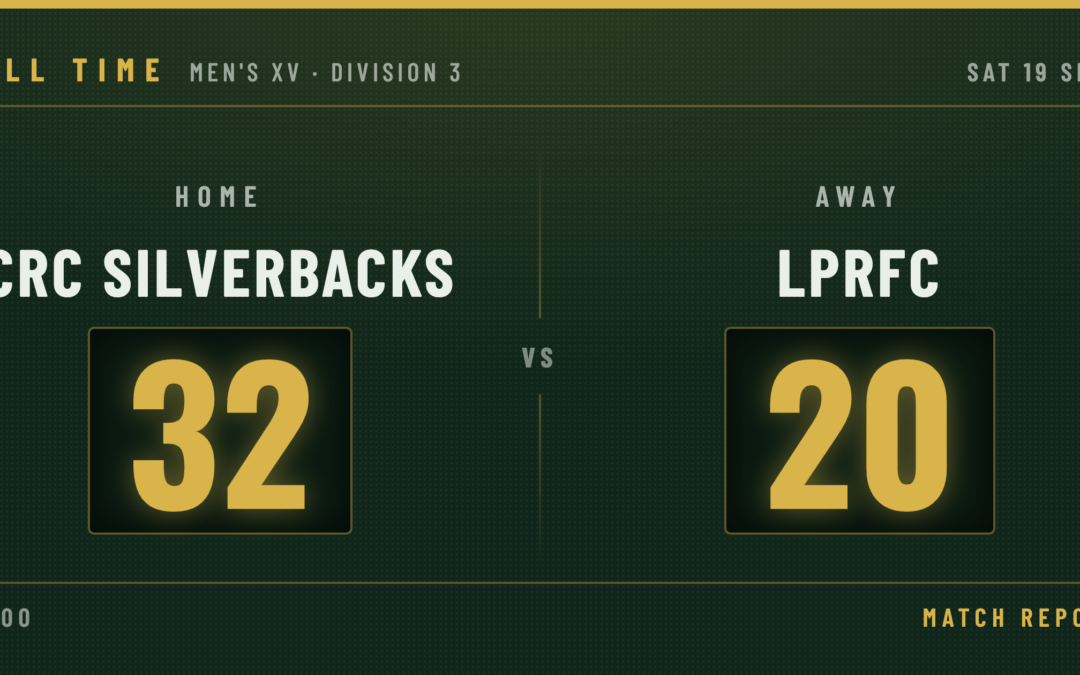
Lincoln Park 48 Silverbacks 19

There was something deliciously appropriate about a Lincoln Park performance this ferocious being merely the undercard. By the time the final whistle brought proceedings to a premature close — both sides apparently needed to be somewhere — Park had already said everything they needed to say, and they had said it loudly. Their teammate Dave Lepp was preparing to walk into a cage that evening and earn a unanimous judges' decision with his fists. His colleagues, it seems, were inspired by the spirit of the thing.

Because this was Lincoln Park with their knuckles up. Aggressive, purposeful, relentless through the phases — and yet, crucially, not brainless. The combination of raw carrying power and genuine structural intelligence was rarer than it sounds, and for long stretches of this contest it was quite irresistible.

The Silverbacks deserve a footnote of credit for their nerve. They crossed early in each half, which takes a certain bloody-mindedness, and they were not short of it. But they were swimming against a tide that grew stronger with every passing minute.

Between those moments of Silverbacks defiance, the scoring belonged entirely to one side. Quinn, operating with the unhurried authority of a man who has done this before, helped himself to two tries from the left wing — both finished with a composure that belied the pressure around him. Hudson spotted the opportunity where others might have clung to the ball and launched the tap-and-go that carved the defence open. And then there was Melody — a man who has scored easier tries only in his sleep — who somehow found himself placing the ball down from a distance measurable in inches rather than yards, and had the good sense not to overthink it.

The forwards carried with menace. The backs ran on to the ball at genuine pace. Would-be tacklers found themselves arriving a fraction too late and leaving a fraction too shaken. The gain line, that great arbiter of rugby contests, was consistently breached and consistently exploited.

Individual excellence threaded through the collective effort like a bright seam. Panzica, who has had company in the lineout struggles of recent weeks, threw with accuracy and conviction, and the set-piece was the better for it. Cooley ran as if he had a personal grievance to settle with every defensive line, scoring himself and unlocking teammates with equal enthusiasm. And Laux and Bricteux? They committed grand larceny at the breakdown with such brazen regularity that one wonders if the Silverbacks have lodged a formal complaint with local law enforcement.

It was a pity the game ended when it did. Not because the result was in doubt — it emphatically was not — but because this was a Lincoln Park performance worth watching to its natural conclusion. There were passages here that deserved a full audience and a full eighty minutes.

Lepp won his fight that night. Unanimously. His teammates had already made the point that victory, when Lincoln Park are operating at this level, can be just as emphatic.

If they carry this with them, the weeks ahead look considerably brighter.

Park pay the price for a slow mind and a slower start

Park pay the price for a slow mind and a slower start

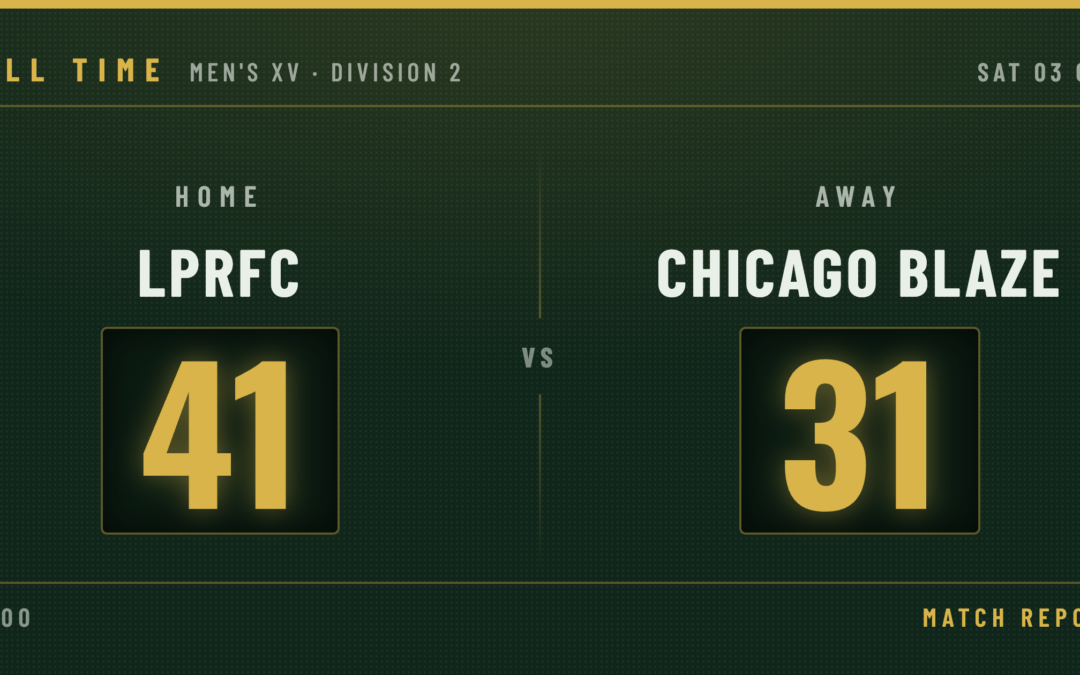
LPRFC 19 Chicago North Side 33

There are defeats and then there are self-portraits, and what Lincoln Park produced here was something uncomfortably close to the latter. Against a NorthSide Chicago side who knew exactly what they were about from the first whistle, Park looked like a team still warming up when the real work had long since begun.

The opening quarter told the story with brutal economy. NorthSide needed no invitation — they simply helped themselves to one, courtesy of an interception as Park attempted to move the ball wide after a high kick. It was the sort of error that happens when minds are elsewhere, and on this evidence, several of Park's were still in the changing room.

"Park looked like a team still warming up when the real work had long since begun."

Credit where it was due: Loomis hauled Lincoln Park back level with a try that had real quality about it — a galloping, long-limbed burst through the midfield that suggested, briefly, a different match might be in the offing. It was not. Two turnovers in quick succession handed NorthSide the initiative back, and their winger proved a menace of the most irritating kind — cutting inside off his wing with the sureness of a man who had done it a hundred times, and would do it again, which he duly did. Two tries from the same source, the same route, the same outcome: 24-7 and the match, to all intents and purposes, already decided.

Geiser's sharp-witted tap penalty on the stroke of half-time reduced the arrears and at least gave Lincoln Park something to build on during the interval conversation. Whether that conversation was frank enough is another matter entirely.

The second half was, at least, a more honest affair — more competitive in spirit if not in arithmetic. Park's try came from Mazy off the bench, a welcome injection of urgency from a substitute who carried more purpose than much of what preceded him. NorthSide added one more of their own to settle the matter beyond doubt, and settled it they did.

The brightest spark throughout, and it should be said loudly, was Schwartz. His running lines through the centres were genuinely clever — not just carrying hard but reading the defence and finding angles that the midfield around him was not always quick enough to exploit. He deserved better support. In the forwards, Tommy Lyons was characteristically industrious at the tackle, and Loomis — scorer and busy presence — gave Lincoln Park some forward momentum in a match where the pack was too often second to the breakdown.

After the quality Park had shown earlier in the campaign, this was a deflating afternoon — not without moments, but profoundly lacking the intensity that had made them worth watching. The table does not forgive slow starts, and neither should the players looking at themselves in the mirror this week.

Bricteux’s brilliance and a first-half carnival light up Lincoln Park

Bricteux’s brilliance and a first-half carnival light up Lincoln Park

Lincoln Park 59  ·  East Side Banshees 43

There are afternoons in club rugby when everything coheres — when the forward grunt meets the backline verve and something genuinely beautiful emerges. Lincoln Park served up one such half on Saturday, and those who witnessed it will be talking about it for some time yet.

Forty-two points in the first half. Let that settle for a moment. Against a Banshees side with enough spirit to make the second period genuinely uncomfortable, Park played rugby of a quality that, frankly, has been waiting to arrive. It arrived in some style.

The architect of much of the devastation was one Bricteux, a backrow with a distinctly Gallic approach to the game — a joie de vivre that a certain Toulouse number eight might recognise, and a taste for the tryline that border on the compulsive. A hat-trick of tries from the loose forward position is not to be sniffed at in any company; at club level, it amounts to a statement of intent. One should note, however, that Bricteux's enthusiasm for the contest did not confine itself to the scoring end. At the breakdown he was, at times, the sort of nuisance that opposing nines have nightmares about. A talent, then, but one that will need channelling.

The old distinction between forwards and backs has always been somewhat reductive, but here it held a pleasant truth. The forwards provided the ingredients — relentlessly, intelligently — and the backs decorated the cake. Chrisos opened the scoring after hooker Medero demonstrated that the modern front-row operator is no longer content merely to scrummage and be thanked for it. The hooker's break to set up the first score was a reminder of a versatility that has been growing by the week; his second-half contribution included a 60-metre effort — his second such score of the season — and a sharp finish to a cutout pass from Nara that showed real footballing awareness. Not bad for a man whose primary obligation remains to point in the right direction at the set-piece.

Geiser's try was everything one hopes for from a prop when he finds himself in the vicinity of the whitewash — low, direct, purposeful, and entirely without apology. A short dive that would have made a seasoned loosehead proud. Meanwhile Hudson, operating from the base of the scrum with the quiet menace of a man who has done this before, helped himself to two tries through the kind of sniping runs that only reveal themselves on the second watching of a video. Blink and you will miss them; Hudson evidently does not blink.

Laux was quick to exploit the quick tap wherever the referee allowed it, putting Park on the front foot with a decisiveness that set the tempo early. In the second row, DRiscoll was an engine of perpetual motion — a player who will look for the offload first, which is commendable, but who is equally unafraid to become the obstacle rather than the architect. He gave Park consistent go-forward when the occasion demanded something more direct. And somewhere in the unglamorous machinery of it all was Debacker, doing the dark arts that the scoresheets never record and the highlights packages never show. Rugby people know the type; they are the first names the coaches thank and the last the reporters mention. Consider this a correction.

Finnegan, standing over the kicking tee with something approaching the clinical authority of a Ramos at his best, converted six from six despite a wind that made no pretence of co-operation. The points column appreciated the effort enormously.

One of the finest halves of rugby this club has produced in a long while.

The Banshees, to their credit, refused to accept the narrative that had been written for them. Minnesota is not a place that produces sportspeople prone to lying down, and their second-half fight-back — clawing back the margin from thirty points to an eventual sixteen — was a reminder that 102-point aggregates do not always tell straightforward stories. At the sixty-minute mark Park appeared comfortable, almost imperious. Then the defensive frailties, always lurking beneath the surface in the early weeks of a season, reasserted themselves. The back door, on too many occasions, was left ajar.

This is the aspect that will exercise the coaching staff in the days ahead, and rightly so. Offensive cohesion of this quality — willing support runners, sharp lines, a shared instinct for when to move and when to commit — is a fragile thing if it is not backed by defensive resolve. Winning by sixteen when leading by thirty is not a disaster; it is, however, a conversation that needs to be had.

But let us not end on a caveat when the headline deserves its moment. Lincoln Park, in that first half, were magnificent. When they play like that, there are not many sides in this league equipped to live with them.


​​

Miracle undone: Park’s magnificent comeback swallowed by a killer last gasp

Miracle undone: Park’s magnificent comeback swallowed by a killer last gasp

Lincoln Park 47 – Chicago Riot 54

They came back from the dead, only for a knife to find them at the final whistle. Lincoln Park's extraordinary second-half fightback — 40 points with the wind at their backs, a levelling score that briefly promised the miraculous — was undone in the cruelest of fashions by a late Chicago Riot try that settled a breathless, high-scoring contest 54-47. It was the kind of afternoon that leaves a dressing room silent for a long time.

The first half was, to be blunt, an embarrassment Lincoln Park will want to forget. Three Riot tries — two converted — put the visitors 19-0 up before the home side had drawn a meaningful breath. The tackling was soft, the defensive line a rumour. Riot established front-foot ball with an ease that should concern the coaching staff, and for long stretches Park resembled a side still warming up.

Credit, then, to prop Melody for finally breaking the duck and giving Park something to build on before the interval. It was the kind of carry a team needs when they are drowning — direct, honest, and desperately welcome. Around him,  Panzica continued to be one of the few to emerge with real credit, his chop-tackle technique a model of low-body efficiency that kept Riot's more powerful runners honest. Equally encouraging was the dynamism of Loomis, an eager, abrasive ball-carrier who never hid and never stopped competing.

Debut man Dalton, thrown into the cauldron on a difficult afternoon, showed the flickers that suggest a future. A couple of shifty, intelligent runs hinted at footwork and awareness beyond the raw numbers on the scoreboard. Young players take time; this one is worth the wait.

The second half, aided considerably by the stiff Chicago wind, was a different story entirely — and a rather thrilling one. The tactical adjustment was the catalyst. Shifting Mazy into the centres and moving Clarke to fly-half provided an immediate injection of go-forward, and with the direct running of Chadwick adding real beef outside him, Park's midfield suddenly looked like something worth fearing. Clarke, freed from the constraints of the first half, began to find the pockets of space behind Riot's defensive line, his raking kicks pinning the visitors deep and forcing the errors that momentum demands.

The try that may live longest in the memory came courtesy of Viele — introduced from the bench, wide on the right, and on hand to dive over for a score with, extraordinarily, his first ever touch of a rugby ball. One suspects he will touch a few more.

Park did enough to level the scores late on, and for a brief, giddy moment, it seemed the comeback had been completed. But rugby is not always kind, and Riot found a response when it mattered most. The final try — late, deflating, definitive — was the final punctuation on a contest that Park, in truth, had made far too hard for themselves in the first 40 minutes.

There is, nonetheless, a broader context to keep in mind. Lincoln Park are a club preparing to step up to Division 3 in the autumn, and afternoons like this one — for all their frustrations — are precisely the examination that such ambition requires. The talent is plainly there. The resilience to haul themselves back from 19 points down is no small thing. The challenge, as it always is, is bringing all of it to bear for the full eighty minutes. When they do, Division 3 will know about it.


Wolfhounds expose Park’s soft underbelly as Cincy run riot in second half

Wolfhounds expose Park’s soft underbelly as Cincy run riot in second half

Lincoln Park 17 Cincinnati 72


There are defeats you can live with, and defeats that expose you. Sunday's contest at Lincoln Park fell emphatically into the second category — a game that started with genuine promise, flickered with individual brilliance, then was swept away in a second-half deluge that left the scoreboard reading like a misprint. Cincinnati Wolfhounds, 72-17. Read it twice if you must.

For the opening quarter, Park were the better side. Bricteaux came agonisingly close to a line break that would have opened the Wolfhounds up entirely, the ball teasing rather than arriving. Quinn looked menacing every time it reached the right wing — a channel Park rightly targeted — and in the pack, Driscoll and Anderson brought exactly the kind of confrontational carrying that sets a platform. The problem, as so often, was the platform's foundations.

The set piece creaked. A scrum lost against the head. Lineout ball compromised by smart Wolfhound jumpers who read the calls well enough to cause repeated disruption. Those are the sort of details that separate a good team from one still finding itself, and Cincinnati knew exactly which buttons to press.

"McCann, two weeks into retirement, was apparently unmoved by the occasion of his own farewell — which is to say he jinked his way over for a try like a man who had never heard the word 'quit.'"

Park did score first, and it was worthy of any highlights reel. Chrisos' grubber was the creative spark; Finnegan's instinctive flick-up the moment of inspiration; Cooley's dive the full stop. Clinical. Clever. It suggested a team capable of manufacturing something from nothing.

But then Wolfhounds arrived at the game. A series of brutal picks close to the line brought them back into it on the half hour. Then — and this is where the afternoon turned — two tries in the final four minutes of the half, the first from an inside centre run of the diagonal, long and weaving and quite frankly beautiful. Park went in at the break trailing 7-21, and the mathematics of recovery were always going to be brutal.

The second half became a different kind of exercise — part damage limitation, part experimentation. Park rotated heavily, as they should at this stage of the spring season, trying combinations and getting minutes into legs. The Wolfhounds, cohesive and untroubled, were happy to oblige. Their young tighthead was a revelation: a barnstorming, bullocking performance that should have coaches across the division taking notes.

Park were not entirely without their moments. Suladze, introduced from the bench, continued the form that is making him impossible to ignore — two steals at the breakdown and a couple of offloads that drew genuine applause. And when Wolfhounds' tighthead came thundering once more, it was Schones who met him with a chop tackle of real quality — the tackle of the day, low and precise and technically excellent.

The consolation scores, at least, arrived with some style. McCann, two weeks into what had apparently been a retirement, was unmoved by the gravity of the occasion — he jinked through a gap, left two defenders clutching at air, and dotted down like a man who had never heard the word 'quit.' And Henneberry found the corner late on to give the scoreline a fraction more dignity.

The visitors deserved their win; that much is beyond argument. But Park are in the business of building right now, not polishing. There were enough individual performances here — Suladze's larceny, Quinn's menace, Anderson and Driscoll's front-foot intent — to suggest the autumn campaign is not a pipe dream. The set piece wants work. The discipline in the final minutes of the first half was costly. These are fixable things. They had better be.